Modular Rack Power Supply System (MRPS) is a ‘creatively’ named system for distributing DC power via USB-C/Power Delivery in a compact compute rack.
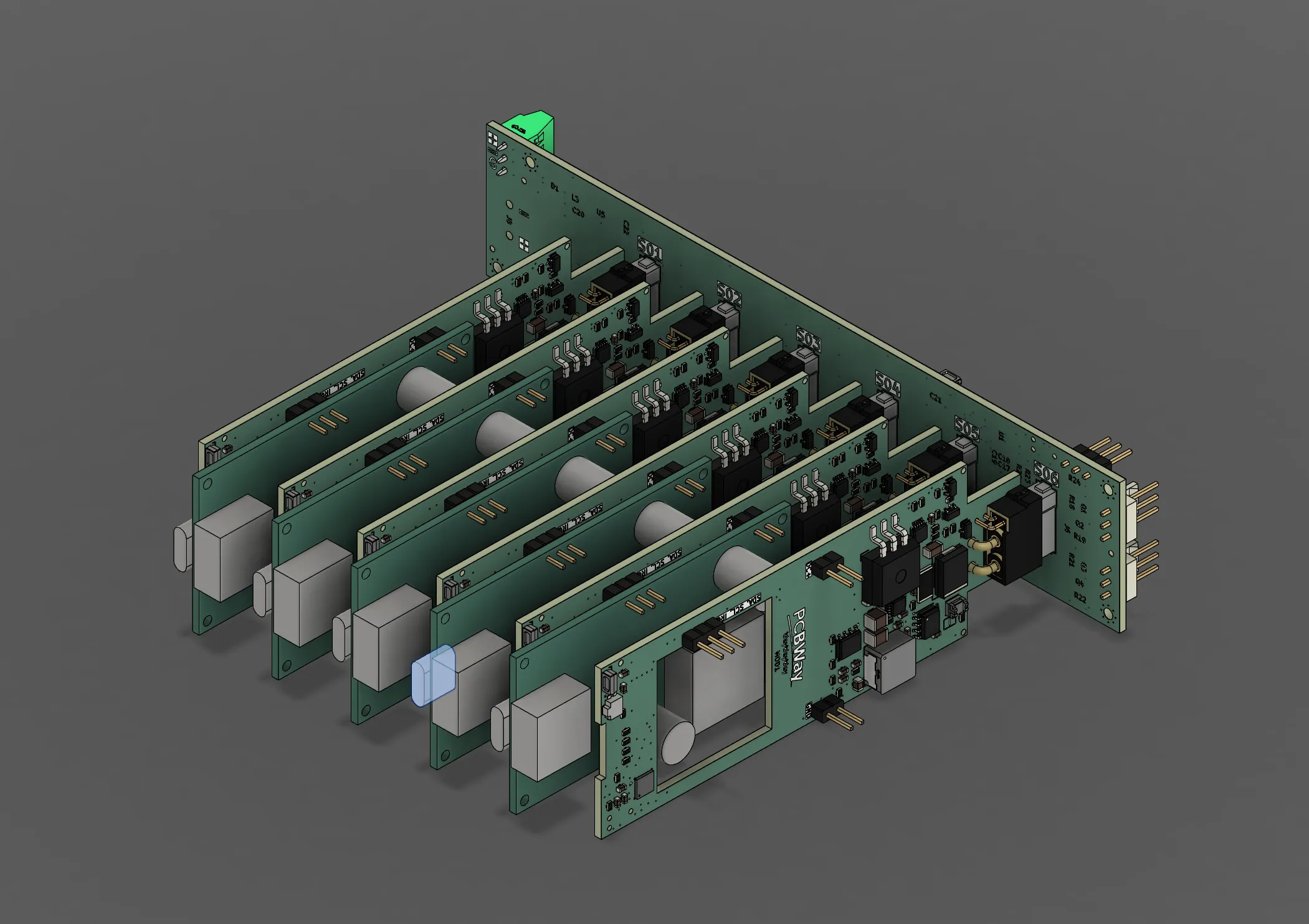
Render of 6 carriers installed in the backplane.
Warning
Everything about this project is still under active development. Discussions about this project are welcome, but keep in mind that it is still in the early stages of development!
What/Why #
Info
If you’re looking for technical documentation about the system, see the
systemsection.
To make a very long story short, the power supply I built years ago to power my Home Lab is no longer adequate for my current needs.
This project is a “do-over” for that earlier power supply and aims to address its limitations while incorporating some modern design principles and technologies like USB-C/Power Delivery.
Goals #
This project was started independently / before I knew about the HomeLab PDU V1 project from Shrike Lab but it does target the same problem space even if this project has different goals.
In no particular order, the values and motivations for this project include:
USB-C/PD is the future.
- Standards Compliance: I intend to adhere to the USB-C/PD standards.
- Only SPR/EPR profiles will be supported.
- AliExpress has a wide variety of USB-C/PD adapters
- It’s trivial to adapt all the custom / proprietary barrel jacks, square shaped connectors and whatever “special” power everything else into a single standard connector.
- Instead of a spaghetti mess of different cables and converters, a single consolidated AC->DC supply for greater efficiency and simplicity.
- Standards Compliance: I intend to adhere to the USB-C/PD standards.
Want to see how far I an push hardware design with the assistance of an LLM.
I get to learn a few things / develop patterns and skills for future projects.
A consolidated power supply must be modular and flexible.
- Workloads are in production so redundancy is important, and a failure should be contained / a single dead port must not bring down the entire system!
Modular design allows customization
- Cost efficiency; spend $ where it matters and go for a cheaper alternative where possible.
- Don’t pay for a USB-C port that can deliver 100W if you only need 10W for that particular device.
- If your power needs grow over time, you can add new modules or upgrade individual modules without replacing the entire system.
- A modular system is inherently scalable.
- If I do this right, it should be straight-forward to adapt this design to different form factors and port counts.
- Cost efficiency; spend $ where it matters and go for a cheaper alternative where possible.
Telemetry
- I like data. I like graphs. I like knowing what my systems are doing.
- A power supply that can’t tell you how much power each load is using is unacceptable
- A power supply that doesn’t let me govern power to individual ports is unacceptable
- This allows for better power management and prevents a single port from monopolizing the available power.
- Also, remote “turn it off and on again” capability for troubleshooting and maintenance.
And a final note on inspiration:
I’ve been following the “DIYson lamp” project for a while now. The guy behind it - @StevenBennettMakes - recently posted this video which he ends with:
What I actually wanted was to be completely absorbed in an engaging and difficult, complicated project that felt kind of important. I wanted to be I wanted to kind of like transcend a hobby and to feel like a compulsion, like something I had to work on. … I actually wanted Tony Stark’s creative flow state. I basically just wanted to like capture that and take it for myself and have it.
I can understand that.